blog
5 Effective Treatments for Periorbital Fine Lines
Table of Contents
- Understanding Periorbital Fine Lines and How They Form
- Fine Lines Around the Eyes Treatment: What Actually Works
- Retinol for Wrinkles Around Eyes: Benefits and Cautions
- Laser Treatment for Wrinkles Around Eyes: What to Expect
- Crow's Feet Treatment: Injectable and Topical Options
- Microneedling and Radiofrequency for Lasting Results
- Choosing the Right Treatment for Periorbital Fine Lines
- Conclusion: Next Steps for Smoother Eyes
- Frequently Asked Questions
Last Updated: October 14, 2026
Understanding Periorbital Fine Lines and How They Form
Periorbital fine lines are small creases that appear in the thin skin around the eyes, caused by collagen breakdown, repeated muscle movement and moisture loss. The skin here is the thinnest on the body, so it shows age earlier than the rest of the face.
A 2024 review of topical active ingredients found that retinoids, peptides and antioxidants were the most effective ingredients for reducing fine lines and improving skin concerns around the eyes (review of topical active ingredients for periorbital skin concerns).
At Glow with Fatima, we see three main drivers in clients: sun damage, expression lines and volume loss. Each one needs a different approach. That is why a single cream rarely fixes everything, and why the five treatments below target the problem from different angles.
Below, we break down what actually works, what it costs you in time and downtime, and how to choose.
Fine Lines Around the Eyes Treatment: What Actually Works
The most effective fine lines around the eyes treatment combines collagen stimulation with targeted active ingredients. No single option does everything, so results improve when you layer approaches over time.
A state-of-the-art review describes modern goals as softening wrinkles, improving skin texture and colour, and restoring volume, not just fading lines (Periorbital Rejuvenation in the Clinic review).
Here is how the main options compare:
| Treatment | How It Works | Best For | Downtime |
|---|---|---|---|
| Retinol | Boosts cell turnover and collagen | Early fine lines | Mild flaking |
| Laser | Removes damaged surface layers | Texture and pigment | 3-7 days |
| Injectables | Relaxes crow's feet muscles | Expression lines | None |
| Microneedling | Triggers collagen via micro-injuries | Texture and scars | 1-2 days |
| Radiofrequency | Heats deeper skin layers | Laxity and firmness | Minimal |
How to Compare Treatment Options
Judge each option on four things: how it works, how much downtime it needs, how many sessions you need, and who it suits. A treatment that works for expression lines will not fix pigment, and the reverse is also true.
Ask three questions before you book anything:
- What is the mechanism, and does it match my concern?
- How many sessions before I see a change?
- What are the realistic risks for my skin type?
Retinol for Wrinkles Around Eyes: Benefits and Cautions
Retinol for wrinkles around eyes remains the best-studied at-home option, but the eye area needs a lower strength than the rest of your face. It speeds up cell turnover and supports collagen, which softens fine lines over months, not days.
The 2024 review named retinoids among the most effective topical ingredients for periorbital concerns (review of topical active ingredients for periorbital skin concerns).
Cautions matter here. The skin around the eyes is delicate, so start with a low concentration twice a week. Expect some dryness and flaking at first. If you are pregnant or breastfeeding, skip retinoids and ask a clinician about alternatives.
- Start low, go slow: twice weekly, then build up
- Apply at night, always follow with moisturiser
- Use SPF every morning without fail
Laser Treatment for Wrinkles Around Eyes: What to Expect
Laser treatment for wrinkles around eyes uses focused light to remove damaged surface skin and trigger fresh collagen. It suits texture and pigment concerns well, and a clinician tailors the strength to your skin.
Expect a consultation first to check your skin type and set realistic goals. Most people need a course of sessions rather than one. Redness and sensitivity for a few days are normal. Deeper resurfacing carries longer downtime and a small risk of pigment changes, especially on darker skin tones.
A 2023 review lists lasers and light among the nonsurgical options for periorbital rejuvenation, alongside fillers and neuromodulators (Periorbital Rejuvenation in the Clinic review).
The honest trade-off: laser gives strong results, but it is not a lunchtime treatment. Plan for recovery time.
Crow's Feet Treatment: Injectable and Topical Options
Crow's feet treatment splits into two camps: injectables that relax the muscle, and topicals that improve the skin itself. Injectables are the faster route for expression lines. Topicals are the slower, at-home route.
A 2017 clinical study found that both tested dilutions were equally effective at reducing lateral periorbital lines when 12 units were used per eye area (study of incobotulinumtoxinA for lateral periorbital lines).
That is a useful finding. It means the dose per area matters more than the specific dilution, so a skilled practitioner can tailor the approach.
On the topical side, peptides and antioxidants support skin quality over time. They will not freeze a muscle, and they are not meant to.
Microneedling and Radiofrequency for Lasting Results
Microneedling and radiofrequency both work by triggering your own collagen, which is why results build over weeks and last longer than surface treatments. Microneedling creates tiny controlled injuries. Radiofrequency heats deeper layers to firm the skin.
A study of a home-use 1440 nm device reported good tolerance and effectiveness for periorbital and perioral wrinkles (study of a home-use device for periorbital wrinkles).
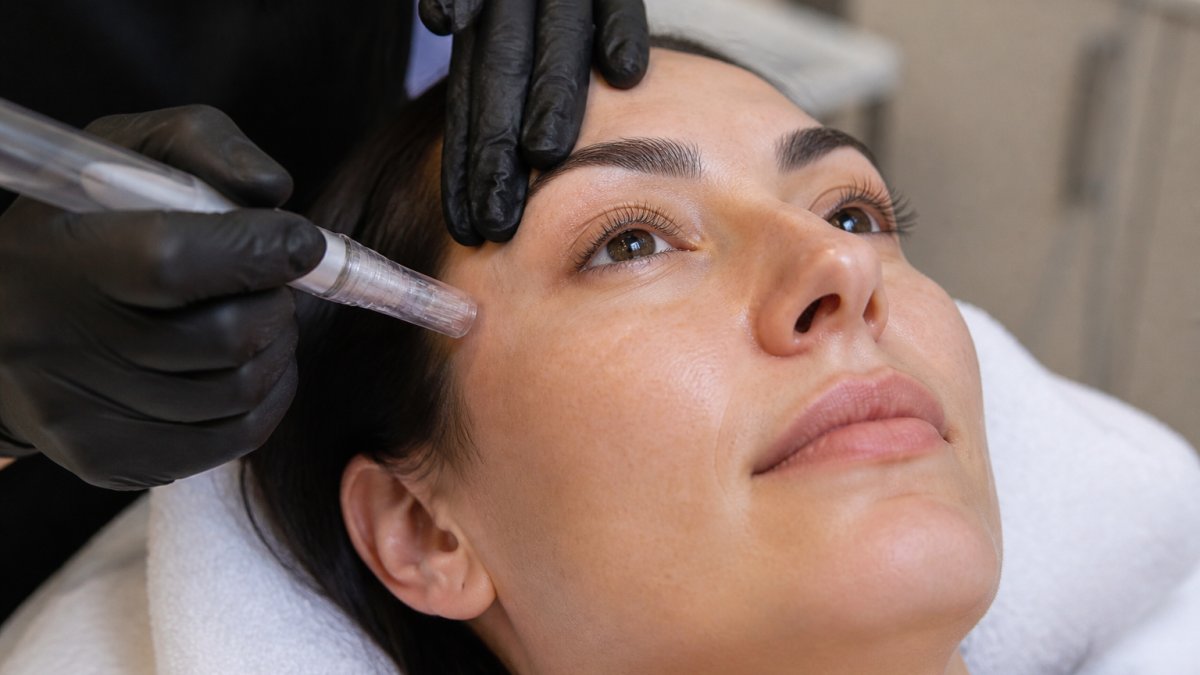
This is where Glow with Fatima focuses its under-eye work. We use the Raffine medical-grade microneedling system, a CE and UKCA-certified device, and run a 3-session protocol so collagen has time to rebuild between visits. It suits texture, fine lines and scarring, including postpartum skin changes.
- Best for: texture, laxity and scars
- Sessions: typically a course of three
- Downtime: one to two days of redness
Choosing the Right Treatment for Periorbital Fine Lines
The right choice depends on your main concern, not on which treatment is trending. Match the mechanism to the problem, then check downtime against your schedule.
- Expression lines: injectables, with topicals to maintain
- Texture and pigment: laser or microneedling
- Early fine lines: retinol and antioxidants
- Laxity and firmness: radiofrequency
If you are unsure, a consultation removes the guesswork. At Glow with Fatima, every plan starts with an assessment of your skin, your history and your goals, so the treatment fits you rather than a template.
Conclusion: Next Steps for Smoother Eyes
Periorbital fine lines respond best to a plan, not a single product. The five treatments above each solve a different part of the puzzle, and the right mix depends on your skin and your goals.
At Glow with Fatima, we build evidence-based plans around your concerns. Our approach uses CE and UKCA-certified medical-grade equipment, a 3-session protocol for optimal results, and a founding model client programme at a reduced rate for those who want to start now.
Book a free consultation and get a plan built around your skin.
Frequently Asked Questions
What is the most effective treatment for fine lines around the eyes?
A 2024 review found that retinoids, peptides and antioxidants are the most effective topical ingredients for reducing fine lines and improving periorbital skin concerns. For in-clinic options, neuromodulators such as incobotulinumtoxinA have shown good results for lateral lines. Combining a topical routine with professional treatments often gives the best outcome. A consultation can help match the right approach to your skin.
Can retinol help with periorbital fine lines?
Yes. Retinol is a retinoid, and a 2024 review identified retinoids as among the most effective ingredients for reducing fine lines and wrinkles around the eyes. Start with a low concentration once or twice a week to build tolerance, and always apply sunscreen during the day. If you have sensitive skin, ask a practitioner about a suitable formulation for the eye area.
Are injectable treatments effective for crow's feet?
A 2017 clinical study found that incobotulinumtoxinA at 12 units per eye area significantly reduced lateral periorbital lines, with both tested dilutions equally effective. Results typically last three to four months. Side effects are usually mild and temporary, such as slight bruising or a brief headache. A qualified practitioner can assess whether this is suitable for you.
How long do treatments for fine lines around the eyes take to work?
Timelines vary. Botulinum toxin injections often show improvement within a week, with full effects at two weeks. Retinol may take eight to twelve weeks of consistent use. Laser and microneedling results build gradually over several sessions, with collagen remodelling continuing for months. Your practitioner can give a realistic timeline based on your treatment plan and skin.
Your questions, answered
What is the most effective treatment for fine lines around the eyes?
A 2024 review found that retinoids, peptides and antioxidants are the most effective topical ingredients for reducing fine lines and improving periorbital skin concerns. For in-clinic options, neuromodulators such as incobotulinumtoxinA have shown good results for lateral lines. Combining a topical routine with professional treatments often gives the best outcome. A consultation can help match the right approach to your skin.
Can retinol help with periorbital fine lines?
Yes. Retinol is a retinoid, and a 2024 review identified retinoids as among the most effective ingredients for reducing fine lines and wrinkles around the eyes. Start with a low concentration once or twice a week to build tolerance, and always apply sunscreen during the day. If you have sensitive skin, ask a practitioner about a suitable formulation for the eye area.
Are injectable treatments effective for crow's feet?
A 2017 clinical study found that incobotulinumtoxinA at 12 units per eye area significantly reduced lateral periorbital lines, with both tested dilutions equally effective. Results typically last three to four months. Side effects are usually mild and temporary, such as slight bruising or a brief headache. A qualified practitioner can assess whether this is suitable for you.
How long do treatments for fine lines around the eyes take to work?
Timelines vary. Botulinum toxin injections often show improvement within a week, with full effects at two weeks. Retinol may take eight to twelve weeks of consistent use. Laser and microneedling results build gradually over several sessions, with collagen remodelling continuing for months. Your practitioner can give a realistic timeline based on your treatment plan and skin.