blog
5 Ways to Improve Skin Texture After Acne
Table of Contents
- Why Acne Leaves Texture Changes Behind
- Retinoids for Acne Scars: Rebuilding Collagen From Within
- Chemical Peels for Acne Scars: Resurfacing Damaged Skin
- Microneedling for Acne Scars: Triggering Natural Repair
- Professional Acne Scar Treatment: Clinical Approaches That Work
- Combining Treatments for Faster Results
- What to Expect: Realistic Timelines and Results
- Frequently Asked Questions
Last Updated: 4 October 2026
Why Acne Leaves Texture Changes Behind
Acne doesn't just disappear. It leaves behind marks on your skin that can last for years. These changes happen because the inflammation damages your skin's structure.
When acne forms, it damages collagen and elastin. These proteins keep your skin firm and smooth. Once they're broken down, your skin loses its even texture. You're left with indented scars, rough patches, or pitted areas.
The good news? Your skin can heal. It just needs the right help.
Here are 5 ways to improve skin texture after acne, all with proven results. They work by triggering your skin's natural repair systems or removing damaged layers so new, healthy skin can surface.
Retinoids for Acne Scars: Rebuilding Collagen From Within
Retinoids boost collagen production from inside your skin. They work by signalling your cells to make more of the proteins that fill in scarred areas.
Retinoids are vitamin A derivatives. They're among the most researched ingredients for skin repair. They don't work overnight, but consistent use shows real changes over weeks and months.
Here's how they help with acne scars:
- Stimulate fibroblasts (collagen-making cells)
- Improve skin thickness and firmness
- Smooth rough, textured skin gradually
- Work on mild to moderate scarring
You can use retinoids at home as a cream or serum. Start with a low strength and build up. Your skin needs time to adjust. Many people see improvements after 8-12 weeks of regular use (pubmed.ncbi.nlm.nih.gov).
The downside? Results are slow. If your scarring is severe, retinoids alone may not be enough. But as part of a combined approach, they're invaluable.
Chemical Peels for Acne Scars: Resurfacing Damaged Skin
Chemical peels remove the top layers of damaged skin so fresh skin can emerge. They work faster than retinoids because they're more aggressive.
A chemical peel uses an acid solution to dissolve the outer skin layers. This sounds harsh, but it's controlled and safe when done properly. The acid depth determines how much skin is removed.
For acne scars, peels work best on surface-level damage and mild pitting. They're less effective on deep indented scars, but they still improve overall texture and tone.
Types of peels for acne scars:
- Superficial peels, lightest option, minimal downtime, gentle results
- Medium peels, moderate strength, some redness for a few days, visible improvement
- Deep peels, strongest option, requires recovery time, best for severe damage
Professional peels deliver better results than at-home versions. A dermatologist or trained aesthetician controls the acid strength and timing. This reduces risk and maximises effectiveness.
Expect some redness and peeling for days after. Your skin will be sensitive. Sunscreen is essential.
Microneedling for Acne Scars: Triggering Natural Repair
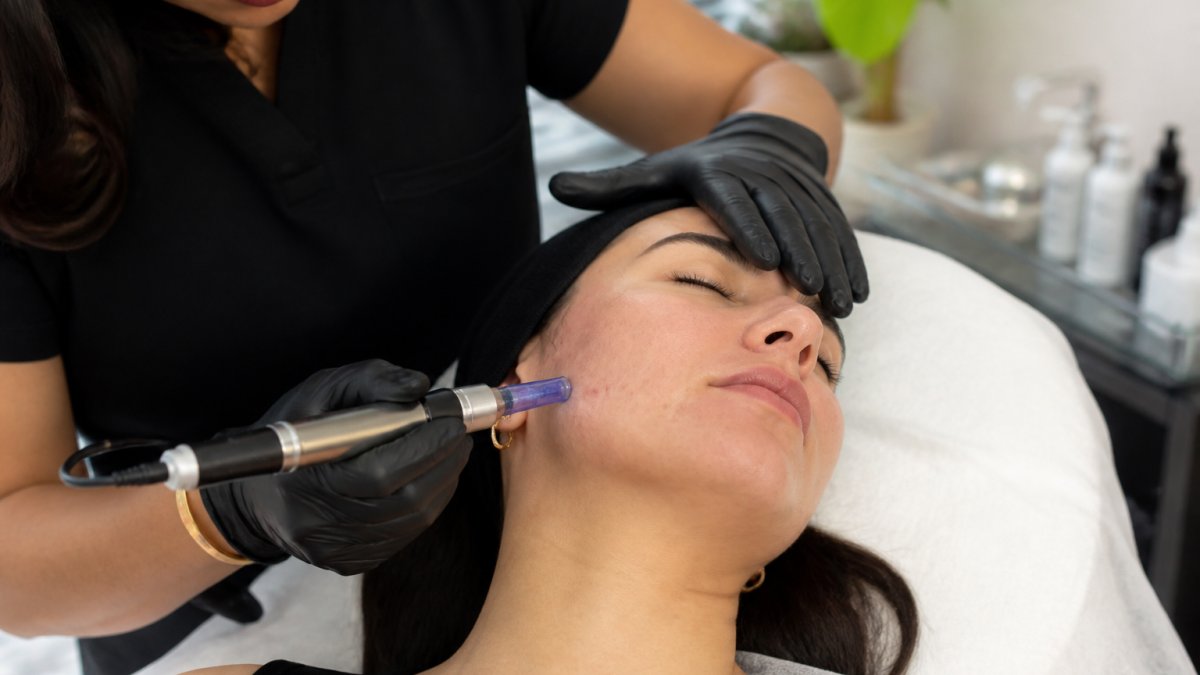
Microneedling creates controlled micro-injuries that trigger your skin's healing response. This stimulates collagen production right where you need it, in the scarred areas.
The treatment uses a device with tiny needles. These needles puncture the skin at precise depths. Your body responds by flooding the area with healing compounds and new collagen.
Microneedling works on all scar types:
- Indented (atrophic) scars from acne
- Rolling scars (wavy texture)
- Boxcar scars (defined edges)
- Ice pick scars (deep, narrow pits)
Research shows improved skin texture after fractional microplasma treatment, which works on similar principles by stimulating the skin's natural repair mechanisms Methods for the Improvement of Acne Scars Used in Dermatology and Cosmetology: A Review.
A single session causes mild redness and swelling for 24-48 hours. Most people return to normal activity the next day. Real results appear over weeks as collagen rebuilds.
Multiple sessions work better than one. Spacing treatments 4-6 weeks apart allows your skin to heal fully between sessions. A series of 3-4 treatments typically shows significant improvement.
Microneedling is less aggressive than chemical peels but more effective than retinoids alone. It's often the middle ground for moderate scarring.
Professional Acne Scar Treatment: Clinical Approaches That Work
Professional treatments go deeper than anything you can do at home. They target severe scarring and deliver faster, more dramatic results.
Fractional laser therapy removes damaged skin layer by layer. The laser creates columns of heat that vaporise scarred tissue. Surrounding healthy skin remains intact, which speeds healing.
Radiofrequency microneedling combines needling with heat energy. This dual action stimulates collagen more intensely than needling alone. The heat also tightens skin, improving texture and firmness.
Subcision is a surgical technique for deep, indented scars. A needle is inserted under the scar to break up scar tissue and release tension. This allows the skin to rise and fill the depression.
These treatments require expertise. They carry more risk than at-home methods, but results are more dramatic.
At Glow with Fatima, we use CE and UKCA-certified medical-grade equipment to deliver clinical results safely. Our evidence-based approach focuses on stimulating natural collagen and elastin production. The 3-session protocol we offer gives your skin time to heal and rebuild between treatments.
Professional treatments typically require downtime. You may experience redness, swelling, or temporary texture changes as your skin heals. This is normal. Results improve over weeks and months as new collagen forms.
Combining Treatments for Faster Results
The fastest way to improve acne scars is combining multiple approaches. One treatment works. Multiple treatments work faster.
Here's why combining works:
- Each method triggers different healing pathways
- They amplify each other's effects
- You address scarring from multiple angles
- Results compound over time
A smart combination might look like:
- Microneedling session + retinoid serum at home
- Chemical peel + growth-factor treatment
- Laser therapy + professional-grade vitamin C serum
- Radiofrequency microneedling + collagen-boosting supplements
The key is spacing treatments properly. Your skin needs 4-6 weeks between major treatments to heal and rebuild. Stacking treatments too close together causes irritation and slows healing.
Professional clinics design protocols around this. They choose treatments that complement each other and time them strategically. This maximises results without overwhelming your skin.
What to Expect: Realistic Timelines and Results
Acne scar improvement takes time. There's no instant fix. But consistent treatment delivers real, lasting changes.
At-home treatments (retinoids, serums, creams):
- Timeline: 8-12 weeks to see noticeable change
- Results: Gradual smoothing, improved texture, mild to moderate improvement
- Commitment: Daily or nightly application
Professional treatments (peels, microneedling, laser):
- Timeline: 4-8 weeks to see results after first session, significant improvement after 3-4 sessions
- Results: Dramatic texture improvement, visible scar reduction, natural-looking outcomes
- Commitment: Multiple sessions spaced 4-6 weeks apart
Severe scarring:
- Timeline: 6-12 months of combined treatment
- Results: Substantial improvement, though deep scars may not disappear completely
- Commitment: Multiple professional treatments plus home care
Your skin improves in layers. The first treatment creates visible change. The second session builds on that. By the third or fourth session, the improvement compounds.
Patience matters. Skin rebuilds slowly. Collagen takes time to form. But if you stick with a protocol, you'll see results.
Acne scars don't have to be permanent. These 5 ways to improve skin texture after acne, retinoids, chemical peels, microneedling, professional laser therapy, and combined protocols, all work. The best choice depends on your scar severity and how quickly you want results.
If you're dealing with textured skin from acne, professional guidance makes a real difference. Glow with Fatima specialises in evidence-based scar treatment using CE and UKCA-certified equipment. Our clinician-led approach means you get a personalised protocol, not a generic treatment. Book a free consultation to discuss which approach suits your skin and your goals. Your naturally radiant skin is worth the investment.
Frequently Asked Questions
How long does it take to improve skin texture after acne?
Improvement timelines vary depending on the treatment method and severity of scarring. Topical retinoids typically show visible results within 8-12 weeks of consistent use, though deeper texture changes develop over 3-6 months. Professional treatments like microneedling often deliver noticeable improvements within 4-6 weeks, with continued enhancement over several months as collagen rebuilds. A structured 3-session protocol can accelerate results, with many people seeing significant texture refinement within 2-3 months.
Can professional acne scar treatment really improve severe scarring?
Yes, professional acne scar treatment has proven effective even for severe, long-standing scarring. Microneedling, chemical peels, and combination protocols stimulate the skin's natural repair mechanisms, rebuilding collagen and elastin beneath scarred tissue. Research shows fractional microplasma treatments improve skin texture in patients with atrophic acne scars after a single session. Results depend on scar depth, skin type, and treatment consistency, which is why evidence-based, personalised protocols, such as a structured 3-session approach, deliver the most reliable outcomes.
Does retinol help improve skin texture after acne?
Retinoids are highly effective for improving acne-scarred skin texture. They increase cell turnover, boost collagen production, and refine the skin's surface over time. Retinol (a gentler form) works well for maintenance and prevention, whilst prescription-strength retinoids like tretinoin deliver faster, more dramatic texture improvements. However, retinoids require patience, visible results typically take 8-12 weeks, and must be introduced gradually to avoid irritation. For severe scarring, combining retinoids with professional treatments like microneedling or chemical peels accelerates improvement.
What makes professional treatments better than at-home skincare for acne scars?
Professional treatments penetrate deeper and trigger more intensive collagen remodelling than topical products alone. Microneedling creates controlled micro-injuries that stimulate the skin's healing response, whilst chemical peels remove damaged surface layers and prompt regeneration. These clinical interventions are customised to your skin type and scar severity, and they're performed with CE and UKCA-certified medical-grade equipment that ensures safety and consistent results. At-home skincare is valuable for maintenance, but professional protocols address the structural damage that topical products cannot reach.
Your questions, answered
How long does it take to improve skin texture after acne?
Improvement timelines vary depending on the treatment method and severity of scarring. Topical retinoids typically show visible results within 8–12 weeks of consistent use, though deeper texture changes develop over 3–6 months. Professional treatments like microneedling often deliver noticeable improvements within 4–6 weeks, with continued enhancement over several months as collagen rebuilds. A structured 3-session protocol can accelerate results, with many people seeing significant texture refinement within 2–3 months.
Can professional acne scar treatment really improve severe scarring?
Yes, professional acne scar treatment has proven effective even for severe, long-standing scarring. Microneedling, chemical peels, and combination protocols stimulate the skin's natural repair mechanisms, rebuilding collagen and elastin beneath scarred tissue. Research shows fractional microplasma treatments improve skin texture in patients with atrophic acne scars after a single session. Results depend on scar depth, skin type, and treatment consistency, which is why evidence-based, personalised protocols—such as a structured 3-session approach—deliver the most reliable outcomes.
Does retinol help improve skin texture after acne?
Retinoids are highly effective for improving acne-scarred skin texture. They increase cell turnover, boost collagen production, and refine the skin's surface over time. Retinol (a gentler form) works well for maintenance and prevention, whilst prescription-strength retinoids like tretinoin deliver faster, more dramatic texture improvements. However, retinoids require patience—visible results typically take 8–12 weeks—and must be introduced gradually to avoid irritation. For severe scarring, combining retinoids with professional treatments like microneedling or chemical peels accelerates improvement.
What makes professional treatments better than at-home skincare for acne scars?
Professional treatments penetrate deeper and trigger more intensive collagen remodelling than topical products alone. Microneedling creates controlled micro-injuries that stimulate the skin's healing response, whilst chemical peels remove damaged surface layers and prompt regeneration. These clinical interventions are customised to your skin type and scar severity, and they're performed with CE and UKCA-certified medical-grade equipment that ensures safety and consistent results. At-home skincare is valuable for maintenance, but professional protocols address the structural damage that topical products cannot reach.