listicle
7 Best Acne Scar Treatments for Deep Scars
Table of Contents
- Quick Comparison: Deep Acne Scar Treatments at a Glance
- 1. Fractional CO2 Laser Resurfacing for Severe Scarring
- Laser Resurfacing Recovery Time: What to Expect
- 2. Subcision: Releasing Tethered Scar Tissue
- 3. RF Microneedling for Deep Acne Scars
- 4. TCA CROSS: Precision Treatment for Ice Pick Scars
- Acne Scar Treatment Cost UK: Investment and Value
- 5. Punch Excision for Permanent Scar Removal
- Frequently Asked Questions
Last Updated: September 23, 2026
Quick Comparison: Deep Acne Scar Treatments at a Glance
If you've lived with deep acne scars for years, you've probably heard conflicting advice. One dermatologist recommends lasers. Another suggests needling. A third mentions chemical peels. The truth is more nuanced: the best treatment for your deep scars depends on their specific type, depth, and how your skin responds to intervention.
Clinical data shows that 75% of patients experience significant scar volume reduction following picosecond laser treatment PMC Advances in the treatment of acne scars, but that doesn't mean lasers are universally the answer. Deep ice pick scars respond poorly to standard resurfacing and often require surgical intervention like punch techniques. Rolling scars benefit from subcision. Boxcar scars might need combination therapy. This guide from Glow with Fatima presents the 7 best acne scar treatments for deep scars, with honest assessments of what works, what doesn't, and what you should expect.
| Treatment | Best For | Starting Price | Recovery Time |
|---|---|---|---|
| Fractional CO2 Laser | Severe, widespread scarring | £500 per session | 7-10 days |
| Subcision | Deep, tethered scars | £300 per session | 3-5 days |
| RF Microneedling | Various scar types | £400 per session | 2-3 days |
| TCA CROSS | Ice pick scars | £150 per session | 5-7 days |
| Punch Excision | Very deep, narrow pits | £450 per procedure | 10-14 days |
| Dermal Fillers | Depressed scars | £350 per syringe | Immediate |
| PRP Therapy | Enhanced microneedling | £400 per session | 2-3 days |
1. Fractional CO2 Laser Resurfacing for Severe Scarring
Fractional CO2 laser resurfacing remains the gold standard for patients with extensive, deep-seated scarring across large areas of the face. This ablative technology removes the outer damaged skin layers whilst stimulating collagen regeneration at depth, addressing the structural damage that defines truly deep scars.
The mechanism is straightforward: the laser creates microscopic channels of thermal injury, triggering your body's natural healing response. Deep collagen remodelling occurs over weeks and months following treatment. For severe cases, fractional CO2 delivers results that non-ablative options simply cannot match.
The tradeoff is significant downtime. Expect 7-10 days of visible redness, peeling, and sensitivity. Your skin will feel raw. You'll need strict sun protection and careful wound care. This isn't a lunch-hour procedure. However, the structural improvements are lasting. One treatment session can shift the appearance of deep scarring by 40-60%, with cumulative improvement across multiple sessions spaced 4-6 weeks apart.
Fractional CO2 works best on lighter skin types, where the contrast between treated and untreated skin is less noticeable. Darker skin tones carry higher risk of post-inflammatory hyperpigmentation, though experienced practitioners can mitigate this with appropriate settings and aftercare protocols.
Laser Resurfacing Recovery Time: What to Expect
Recovery from fractional CO2 resurfacing follows a predictable timeline, though individual variation exists. Days 1-3 involve significant redness, swelling, and oozing. Your skin will feel tight and uncomfortable. Days 4-7 bring peeling and flaking as the damaged outer layer sheds. Days 7-10 see the intensity of redness diminish, though some pink tone persists for 2-4 weeks.
Full recovery, meaning you can resume normal activities without obvious signs of treatment, typically takes 10-14 days. However, residual redness can linger for 4-6 weeks, particularly around the eyes and cheeks. Sun exposure during this window will deepen hyperpigmentation and delay healing.
The real timeline for scar improvement is measured in months, not days. Collagen remodelling accelerates over 8-12 weeks post-treatment. Many practitioners recommend a series of 2-3 treatments spaced 6-8 weeks apart for optimal structural change.
2. Subcision: Releasing Tethered Scar Tissue
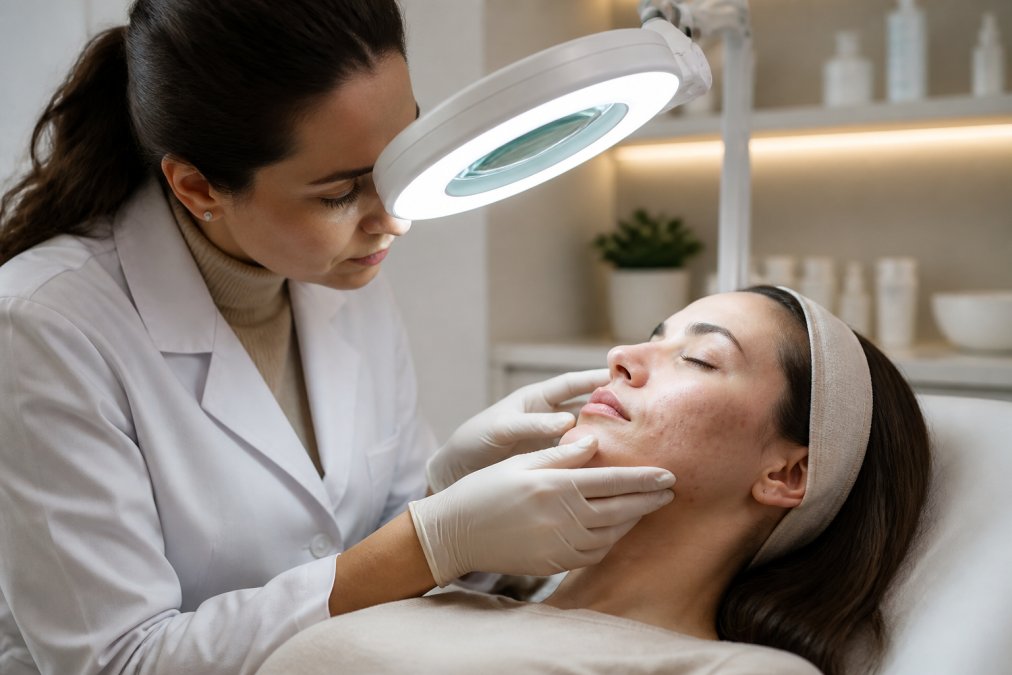
Deep scars often aren't truly "deep" in the way you might imagine. Instead, they're tethered, fibrous bands of scar tissue have attached the skin to underlying structures, pulling the surface downward and creating the appearance of a pit. Subcision directly addresses this root cause.
The procedure involves inserting a bevelled needle beneath the scar and moving it back and forth to break the fibrous attachments. This allows the skin to lift and level. Subcision is particularly effective for rolling scars and depressed scars with clear tethering. It's less useful for ice pick scars, which are genuinely deep and narrow.
Recovery is gentler than laser treatment. Expect 3-5 days of bruising and swelling. The real benefit emerges over weeks as the lifted skin heals and collagen fills the space. Many practitioners combine subcision with dermal fillers for immediate visual improvement whilst the underlying structural healing occurs.
The limitation: subcision alone won't eliminate very deep scars. Most practitioners use it as part of combination therapy, subcision to release the tether, then laser resurfacing or microneedling to stimulate collagen and further improve texture. This staged approach addresses both the structural problem and the textural damage.
3. RF Microneedling for Deep Acne Scars
RF (radiofrequency) microneedling combines two mechanisms: mechanical injury from the needles and thermal energy from radiofrequency waves. This dual action stimulates collagen at multiple depths, making it effective for moderate to deep scarring without the downtime of ablative lasers.
The needles penetrate to adjustable depths, typically 2-4mm for scar treatment, whilst delivering radiofrequency energy. This heats the dermis, triggering collagen synthesis and remodelling. The mechanical needling creates controlled injury, further activating the healing cascade. The result is gradual but sustained improvement in scar depth and texture.
What makes RF microneedling appealing is the recovery profile. Expect 2-3 days of redness and mild swelling. Most people return to normal activities immediately, though sun protection is essential. Results improve progressively over 8-12 weeks as collagen regenerates.
The catch: RF microneedling requires multiple sessions, typically 3-4 treatments spaced 4-6 weeks apart, for significant improvement in deep scars. Single sessions produce minimal visible change. This extends the treatment timeline and total cost, though the cumulative effect can be impressive.
RF microneedling works across all skin types with lower risk of pigmentation changes compared to ablative lasers, making it a safer choice for darker skin tones seeking deep scar treatment.
4. TCA CROSS: Precision Treatment for Ice Pick Scars
TCA CROSS, Chemical Reconstruction of Skin Scars, is a precision technique using high-concentration trichloroacetic acid applied directly to individual scars. It's particularly useful for ice pick scars and narrow, deep boxcar scars that respond poorly to standard resurfacing Dr Caroline Warden acne scar treatment guidance.
The procedure involves applying concentrated TCA (70-100%) directly into each scar pit using a wooden applicator or needle. The acid induces controlled chemical injury, triggering localised inflammation and subsequent collagen regeneration. The precision is the key advantage: you're treating only the scar, not the surrounding skin.
Results develop gradually. Scars typically improve by 30-50% per treatment.
Acne Scar Treatment Cost UK: Investment and Value
Scar treatment costs vary significantly based on the method, the extent of scarring, and the number of sessions required. For current pricing and package options, please book a free consultation with Glow with Fatima.
5. Punch Excision for Permanent Scar Removal
For the deepest, narrowest ice pick scars that don't respond to resurfacing or chemical approaches, punch excision offers a surgical solution. A small cylindrical tool removes the scar tissue entirely, and the edges are stitched together, leaving a finer linear scar in place of the deep pit.
Frequently Asked Questions
Can deep acne scars be removed completely?
Complete removal depends on scar depth and type. Clinical data shows 75% of patients experience significant scar volume reduction with picosecond laser treatment. Punch excision permanently removes deep ice pick scars by surgical extraction, whilst combination therapies like subcision plus laser resurfacing substantially improve severe scarring. However, very deep pitted scars may leave a faint trace rather than disappear entirely. A consultation with a practitioner can assess your specific scars and realistic outcomes.
What is the most effective treatment for pitted acne scars?
For pitted acne scars, fractional CO2 laser resurfacing and RF microneedling rank among the most effective options. Fractional CO2 removes damaged outer layers and stimulates deep collagen regeneration, ideal for severe pitting. For deep, narrow ice pick scars, TCA CROSS offers precision targeting. Punch techniques work best for 3-4 mm deep scars. Most practitioners recommend combining resurfacing with subcision to address both surface texture and underlying tethering, delivering superior structural changes.
Are there non-surgical options for deep acne scarring?
Yes. Non-surgical options include fractional CO2 laser resurfacing, RF microneedling, TCA CROSS, dermal fillers, and PRP therapy. These avoid surgical incisions but require multiple sessions for deep scars. Fillers provide immediate softening but are temporary. Laser and microneedling treatments stimulate lasting collagen remodelling over weeks. For very deep tethered scars, subcision is minimally invasive but technically surgical. A combination approach, laser plus microneedling plus chemical peels, often achieves better structural improvement than any single treatment alone.
How many sessions are typically required for acne scar treatment?
Session requirements vary by treatment and scar severity. RF microneedling and fractional CO2 typically require 3-6 sessions spaced 4-8 weeks apart. TCA CROSS may need 2-4 sessions per scar. Subcision often requires 1-2 sessions, sometimes combined with fillers. Dermal fillers need touch-ups every 6-12 months. Punch excision is usually a single procedure. Combination protocols, such as laser resurfacing followed by microneedling and chemical peels, deliver faster results. Your practitioner will design a personalised schedule based on your scar type and skin response.
What is the difference between ice pick and boxcar scars?
Ice pick scars are narrow, deep vertical pits resembling puncture wounds, typically 1-2 mm wide but 3-4 mm deep. Boxcar scars are wider, depressed areas with defined edges, resembling small boxes or chickenpox marks. Ice pick scars respond well to TCA CROSS and punch techniques because their narrow depth suits precision targeting. Boxcar scars benefit from fractional CO2 and subcision, which address the broader depressed area and underlying tethering. Understanding your scar type helps determine the most effective treatment pathway.
Your questions, answered
Can deep acne scars be removed completely?
Complete removal depends on scar depth and type. Clinical data shows 75% of patients experience significant scar volume reduction with picosecond laser treatment. Punch excision permanently removes deep ice pick scars by surgical extraction, whilst combination therapies like subcision plus laser resurfacing substantially improve severe scarring. However, very deep pitted scars may leave a faint trace rather than disappear entirely. A consultation with a practitioner can assess your specific scars and realistic outcomes.
What is the most effective treatment for pitted acne scars?
For pitted acne scars, fractional CO2 laser resurfacing and RF microneedling rank among the most effective options. Fractional CO2 removes damaged outer layers and stimulates deep collagen regeneration, ideal for severe pitting. For deep, narrow ice pick scars, TCA CROSS offers precision targeting. Punch techniques work best for 3–4 mm deep scars. Most practitioners recommend combining resurfacing with subcision to address both surface texture and underlying tethering, delivering superior structural changes.
Are there non-surgical options for deep acne scarring?
Yes. Non-surgical options include fractional CO2 laser resurfacing, RF microneedling, TCA CROSS, dermal fillers, and PRP therapy. These avoid surgical incisions but require multiple sessions for deep scars. Fillers provide immediate softening but are temporary. Laser and microneedling treatments stimulate lasting collagen remodelling over weeks. For very deep tethered scars, subcision is minimally invasive but technically surgical. A combination approach—laser plus microneedling plus chemical peels—often achieves better structural improvement than any single treatment alone.
How many sessions are typically required for acne scar treatment?
Session requirements vary by treatment and scar severity. RF microneedling and fractional CO2 typically require 3–6 sessions spaced 4–8 weeks apart. TCA CROSS may need 2–4 sessions per scar. Subcision often requires 1–2 sessions, sometimes combined with fillers. Dermal fillers need touch-ups every 6–12 months. Punch excision is usually a single procedure. Combination protocols, such as laser resurfacing followed by microneedling and chemical peels, deliver faster results. Your practitioner will design a personalised schedule based on your scar type and skin response.
What is the difference between ice pick and boxcar scars?
Ice pick scars are narrow, deep vertical pits resembling puncture wounds, typically 1–2 mm wide but 3–4 mm deep. Boxcar scars are wider, depressed areas with defined edges, resembling small boxes or chickenpox marks. Ice pick scars respond well to TCA CROSS and punch techniques because their narrow depth suits precision targeting. Boxcar scars benefit from fractional CO2 and subcision, which address the broader depressed area and underlying tethering. Understanding your scar type helps determine the most effective treatment pathway.