listicle
Alternatives to Chemical Peels for Sensitive Skin
Table of Contents
- Why Sensitive Skin Often Needs a Chemical Peel Alternative
- Gentle Exfoliation for Sensitive Skin: What Actually Works
- Enzyme Exfoliation for Sensitive Skin: The Non-Acid Option
- Professional Treatments That Skip the Acid
- How to Brighten Sensitive Skin Without Irritation
- Building a Skin Barrier Repair Routine
- What to Avoid and How to Choose a Chemical Peel Alternative
- Frequently Asked Questions
Last Updated: 12 October 2026
Why Sensitive Skin Often Needs a Chemical Peel Alternative
If your skin flares at the first hint of acid, you are not imagining it. A review in the Journal of Clinical and Aesthetic Dermatology examined how peel depth and type drive irritation, and found that choosing the wrong strength is one of the main reasons reactions occur. For reactive skin, that margin for error is thin.
This guide from Glow with Fatima maps out the alternatives to chemical peels for sensitive skin that actually respect a fragile barrier. Below, we break down what works, what to avoid, and how to match a treatment to your concern.
The core problem is simple: a peel works by controlled injury. Sensitive skin already sits close to its tolerance ceiling, so even a mild acid can tip it into redness, stinging and post-inflammatory pigmentation.
Gentle Exfoliation for Sensitive Skin: What Actually Works
Gentle exfoliation for sensitive skin means removing dead surface cells without stripping the barrier that protects them. The goal is smoother texture and better product absorption, not visible peeling.
What works comes down to frequency and form. Most reactive skin tolerates exfoliation once or twice a week, not daily. The gentlest routes are:
- Enzyme-based masks that dissolve dead cells without acid
- Soft physical exfoliants with rounded, synthetic beads rather than rough natural grains
- Low-strength polyhydroxy acids (PHAs), which have larger molecules and sit mostly on the surface
A 2026 guide from ProMD Health lists dermaplaning, microdermabrasion and HydraFacial as ways to refresh tone for general dullness and mild discolouration. None of these suits every sensitive-skin concern, so patch-test first.
Physical vs Chemical Exfoliation: Which Suits Reactive Skin?
Physical exfoliation uses friction; chemical exfoliation uses acids or enzymes to loosen the bonds between dead cells.
For reactive skin, physical exfoliation is often the safer starting point because you control the pressure and stop the moment you feel stinging. Chemical exfoliation can be gentler in the right hands, but concentration is everything. The same review noted that peel selection depends on depth and indication, which is exactly why sensitive skin needs a lower-strength, professional approach.
Enzyme Exfoliation for Sensitive Skin: The Non-Acid Option
Enzyme exfoliation for sensitive skin uses fruit-derived enzymes, such as papain and bromelain, to digest dead surface cells instead of dissolving them with acid. Because it works without lowering skin pH, it tends to cause less stinging.
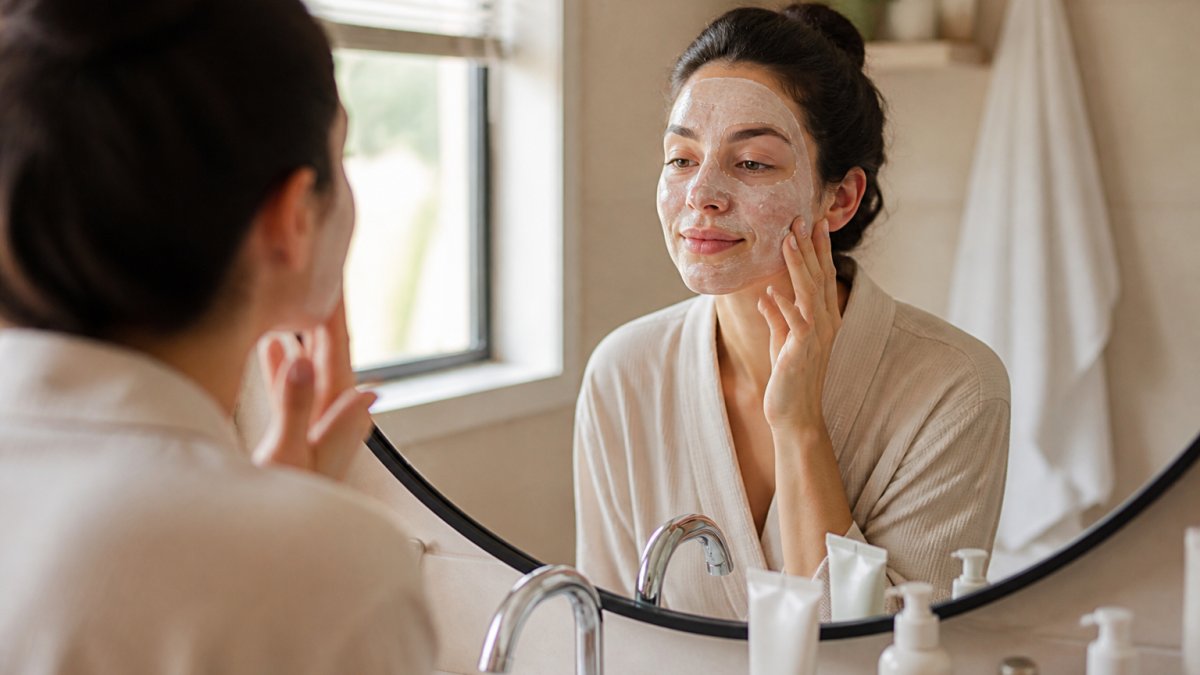
This is the category most reactive-skin clients ask us about first. It is also the one with the widest quality gap: a well-formulated enzyme mask is soothing, while a cheap one can still irritate.
The trade-off is depth. Enzymes work on the surface, so they are excellent for dullness and congestion but limited for scarring or pigmentation. For those concerns, you need a professional treatment that reaches deeper without acid.
Professional Treatments That Skip the Acid
Professional non-peel treatments can deliver real change for sensitive skin, but each has a different mechanism and a different risk profile. Here is how the main options compare.
| Treatment | Mechanism | Best For | Sensitive-Skin Caution |
|---|---|---|---|
| Microneedling | Fine needles trigger collagen | Texture, scars, fine lines | Avoid during active breakouts |
| HydraFacial | Vortex cleanse and hydrate | Dullness, mild discolouration | Patch-test first |
| Dermaplaning | Physical removal of surface hair and cells | Smoothness, glow | Avoid on active acne |
| Microdermabrasion | Abrasion of the surface layer | Mild tone issues | Can aggravate reactive skin |
| Enzyme treatments | Enzymes digest dead cells | Dullness, congestion | Lowest irritation risk |
The 2010 review in the Journal of Clinical and Aesthetic Dermatology noted that laser techniques are a popular alternative for major deep resurfacing because they avoid some adverse effects linked to deep chemical peels. That does not make them interchangeable with a peel, and it does not suit every sensitive-skin concern.
Microneedling and Collagen Induction
Microneedling uses fine needles to create controlled micro-channels in the skin, triggering the body's own collagen and elastin production. For sensitive skin, it is appealing because it does not strip the surface with acid.
At Glow with Fatima, we use the Raffine medical-grade microneedling system, a CE-certified and UKCA-certified device, as part of a three-session protocol. The approach suits texture, fine lines and scarring rather than simple dullness.
How to Brighten Sensitive Skin Without Irritation
Learning how to brighten sensitive skin starts with slowing down. Most brightening actives, including vitamin C and retinoids, are the same ingredients that trigger reactions in reactive skin.
The safer route is to build tolerance gradually and prioritise barrier support over aggressive brightening. Retinol is a common at-home alternative for texture, ageing and acne, but the research does not confirm it suits sensitive skin, so introduce it slowly and at low strength.
A practical brightening sequence looks like this:
- Patch-test any new active on your jawline for three nights
- Start at half the recommended frequency
- Buffer with a barrier cream before applying the active
- Stop at the first sign of persistent stinging
Building a Skin Barrier Repair Routine
A skin barrier repair routine is the foundation that makes every other treatment tolerable. Without it, even the gentlest exfoliant will eventually cause problems.
The barrier is the outer layer of skin that holds in water and keeps irritants out. When it is compromised, you get tightness, redness and a stinging sensation that no amount of exfoliation will fix.
A repair routine keeps things minimal:
- A gentle, non-foaming cleanser
- A ceramide or squalane-based moisturiser
- A broad-spectrum SPF every morning
- One active at a time, never stacked
What to Avoid and How to Choose a Chemical Peel Alternative
Choosing a chemical peel alternative for sensitive skin comes down to matching the mechanism to your concern, not chasing the strongest option. The wrong choice wastes money and can set your barrier back months.
Avoid anything that promises deep resurfacing at home, strong acid concentrations, and daily exfoliation. These are the fastest routes to irritation for reactive skin.
When you choose, ask three questions:
- Does the mechanism suit my concern, or just my budget?
- Is the provider qualified to assess my skin before treating it?
- What is the plan if my skin reacts?
For concerns like acne scarring or under-eye hollowing, an at-home product will not deliver. Those need a professional assessment and a treatment plan built around your skin.
Sensitive skin does not have to mean settling for dull, uneven texture. The challenge is finding treatments that respect your barrier while still delivering visible results, and that is exactly where expert guidance matters.
At Glow with Fatima, we build bespoke plans around evidence-based treatments, a three-session protocol for optimal results, and medical-grade equipment that is CE and UKCA-certified. Our founding model client programme is available at a reduced rate for those starting their skin journey.
Book a free consultation with Glow with Fatima and get a plan matched to your skin, not a generic package.
Frequently Asked Questions
What is a gentle alternative to a chemical peel for sensitive skin?
Enzyme exfoliation and gentle physical exfoliants are commonly cited alternatives. A 2018 review in the Journal of Clinical and Aesthetic Dermatology notes that peel selection depends on skin type and concern, so reactive skin often benefits from lower-intensity options. Professional treatments such as HydraFacial, dermaplaning and microdermabrasion are also listed as non-peel choices for dullness and mild discolouration, though the research does not confirm they suit every sensitive-skin condition.
How can I exfoliate sensitive skin without using acids?
Enzyme exfoliation uses fruit-derived enzymes rather than acids to loosen dead surface cells, making it a gentler route for reactive skin. Physical options like dermaplaning or microdermabrasion are also available professionally. The 2010 Journal of Clinical and Aesthetic Dermatology review notes that laser techniques avoid some adverse effects linked to deep chemical peels. Whichever route you take, patch-test first and keep frequency low, since over-exfoliation is a common trigger for sensitivity.
Is enzyme exfoliation gentler than a chemical peel?
Enzyme treatments are typically described as gentle non-peel alternatives in consumer guidance, but the research does not establish that they are interchangeable with chemical peels. The 2010 review confirms that alternatives vary in depth and suitability depending on the concern being treated. Enzyme exfoliation may suit mild dullness or surface texture, while deeper concerns such as significant pigmentation or scarring may need a different approach assessed by a qualified practitioner.
What professional skin treatments are suitable for sensitive skin?
Research lists HydraFacial, dermaplaning, microdermabrasion, oxygen facials, light-based facials and microneedling among non-peel options. The 2010 review notes laser techniques are popular for deep resurfacing because they avoid certain adverse effects of deep chemical peels. Suitability depends on your specific concern and skin reactivity, so a professional consultation is the safest way to match treatment to skin type.
How can I brighten sensitive skin without a chemical peel?
Focus on barrier support first: a consistent skin barrier repair routine with gentle cleansing and moisturising reduces reactivity, which in turn helps even out tone. Enzyme exfoliation and gentle exfoliation for sensitive skin can lift dullness without acid irritation. The 2026 guide from ProMD Health lists HydraFacial, dermaplaning and microdermabrasion as options for mild discolouration, though it provides no comparative outcome data, so results vary.
Your questions, answered
What is a gentle alternative to a chemical peel for sensitive skin?
Enzyme exfoliation and gentle physical exfoliants are commonly cited alternatives. A 2018 review in the Journal of Clinical and Aesthetic Dermatology notes that peel selection depends on skin type and concern, so reactive skin often benefits from lower-intensity options. Professional treatments such as HydraFacial, dermaplaning and microdermabrasion are also listed as non-peel choices for dullness and mild discolouration, though the research does not confirm they suit every sensitive-skin condition.
How can I exfoliate sensitive skin without using acids?
Enzyme exfoliation uses fruit-derived enzymes rather than acids to loosen dead surface cells, making it a gentler route for reactive skin. Physical options like dermaplaning or microdermabrasion are also available professionally. The 2010 Journal of Clinical and Aesthetic Dermatology review notes that laser techniques avoid some adverse effects linked to deep chemical peels. Whichever route you take, patch-test first and keep frequency low, since over-exfoliation is a common trigger for sensitivity.
Is enzyme exfoliation gentler than a chemical peel?
Enzyme treatments are typically described as gentle non-peel alternatives in consumer guidance, but the research does not establish that they are interchangeable with chemical peels. The 2010 review confirms that alternatives vary in depth and suitability depending on the concern being treated. Enzyme exfoliation may suit mild dullness or surface texture, while deeper concerns such as significant pigmentation or scarring may need a different approach assessed by a qualified practitioner.
What professional skin treatments are suitable for sensitive skin?
Research lists HydraFacial, dermaplaning, microdermabrasion, oxygen facials, light-based facials and microneedling among non-peel options. The 2010 review notes laser techniques are popular for deep resurfacing because they avoid certain adverse effects of deep chemical peels. Suitability depends on your specific concern and skin reactivity, so a professional consultation is the safest way to match treatment to skin type.
How can I brighten sensitive skin without a chemical peel?
Focus on barrier support first: a consistent skin barrier repair routine with gentle cleansing and moisturising reduces reactivity, which in turn helps even out tone. Enzyme exfoliation and gentle exfoliation for sensitive skin can lift dullness without acid irritation. The 2026 guide from ProMD Health lists HydraFacial, dermaplaning and microdermabrasion as options for mild discolouration, though it provides no comparative outcome data, so results vary.