how-to
How to Treat Post-Partum Skin Texture: A 2026 Guide
Table of Contents
- Why Post-Partum Skin Texture Changes Happen
- Postpartum Skin Barrier Repair: The First Step
- Best Skincare Ingredients for Breastfeeding Mums
- Managing Postpartum Hormonal Acne at Home
- In-Clinic Treatments for Post-Partum Skin Texture
- Building a Simple Daily Routine That Works
- When to See a Professional About Post-Partum Skin Texture
- Frequently Asked Questions
Last Updated: September 15, 2026
Why Post-Partum Skin Texture Changes Happen
Post-partum skin texture changes happen because pregnancy hormones drop sharply after birth, and the skin loses the collagen support that kept it firm. Research published in a 2025 study on pregnancy-related skin changes in the National Library of Medicine found that both pregnancy and the postpartum period cause significant physiological skin changes that directly shape how women feel about their skin. This guide from Glow with Fatima explains what actually works.
You are not imagining the difference. The skin you had before pregnancy was supported by a different hormonal environment.
Hormonal Shifts and Collagen Loss
Oestrogen and progesterone fall within days of giving birth. Collagen production slows with them.
The result is skin that feels looser, looks duller, and shows texture it never showed before. Add broken sleep and dehydration from breastfeeding, and the barrier weakens further.
That combination, not "bad skin", is what you are looking at.
Postpartum Skin Barrier Repair: The First Step
Postpartum skin barrier repair is the process of restoring the skin's outer protective layer before treating texture, pigmentation or laxity. Without it, active ingredients and in-clinic treatments cause irritation instead of improvement.
Most women do this backwards. They reach for retinol and acids to fix texture, and the barrier collapses.
Start here instead:
- Switch to a gentle, non-foaming cleanser
- Apply a ceramide or squalane moisturiser twice daily
- Use SPF 30 or higher every morning, indoors included
- Pause all exfoliating acids for at least two weeks
Best Skincare Ingredients for Breastfeeding Mums
The best skincare ingredients for breastfeeding are those with strong safety records and no systemic absorption: niacinamide, azelaic acid, hyaluronic acid, vitamin C, and ceramides. Retinoids and high-dose salicylic acid are the two to avoid (the NHS).
Pregnancy and Breastfeeding Skincare Swaps | Dermatologist Approved
Dr. Aleksandra Brown DO, FAAD
Niacinamide is the workhorse here. It improves texture, calms redness and supports barrier repair at concentrations from 4%.
Azelaic acid suits the pigmentation that often accompanies post-partum texture. Vitamin C brightens and defends against free radicals.
Dermatological guidance increasingly favours a pared-back routine focused on barrier repair rather than complex multi-step regimens, per Tenth Wellness skincare guidance.
| Concern | Ingredient to Try | Avoid While Breastfeeding |
|---|---|---|
| Rough texture | Niacinamide 4-5% | Retinoids |
| Dullness | Vitamin C | High-dose salicylic acid |
| Dryness | Ceramides, squalane | Essential oil blends |
| Pigmentation | Azelaic acid | Hydroquinone |
| Fine lines | Hyaluronic acid | Prescription tretinoin |
Managing Postpartum Hormonal Acne at Home
Managing postpartum hormonal acne at home comes down to consistency and restraint: a gentle cleanser, one active ingredient, and patience. Most flare-ups settle within three to six months as hormones stabilise.
Breakouts after birth usually appear along the jaw and chin. They respond to azelaic acid or a low-strength benzoyl peroxide, applied to the whole area rather than individual spots.
Do not add three new products at once. If something irritates, you will not know which one caused it.
In-Clinic Treatments for Post-Partum Skin Texture
In-clinic treatments for post-partum skin texture work by stimulating collagen and elastin below the surface, which no cream can reach. Energy-based options include medical-grade microneedling, HIFU, and laser resurfacing.
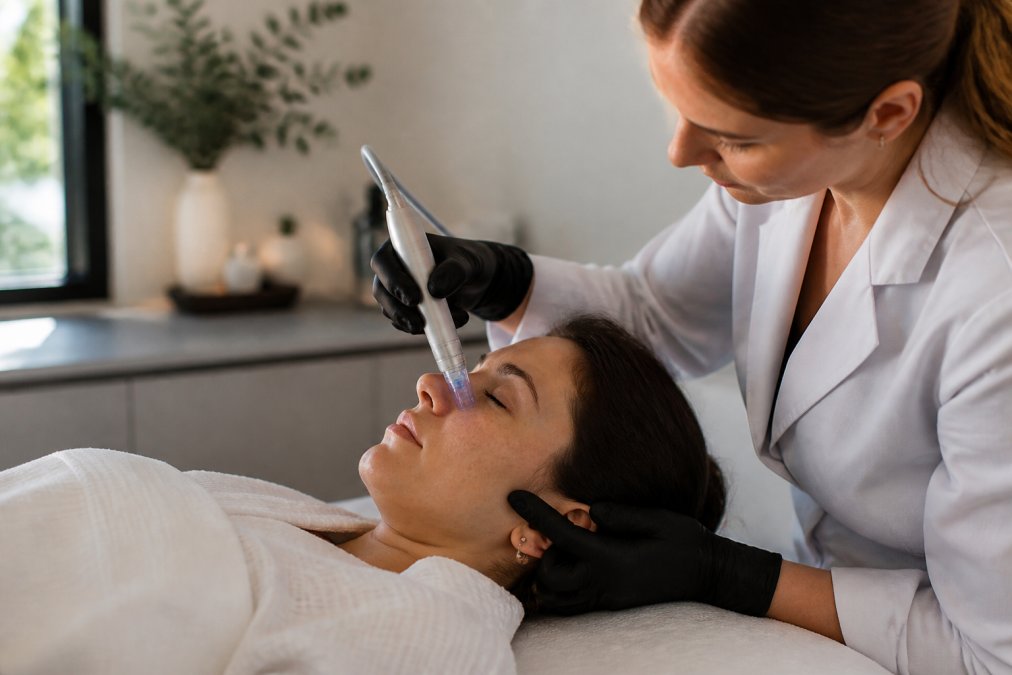
At Glow with Fatima, we use the Raffine medical-grade microneedling system, a CE-certified and UKCA-certified device, within a three-session protocol designed for cumulative results. Because the studio was founded by a practitioner with a clinical care background, treatment plans are built around your skin's actual condition rather than a fixed package.
If you are postpartum and your skin has changed in ways you have never dealt with, this is precisely the situation these protocols are designed for.
Building a Simple Daily Routine That Works
A routine that works for post-partum skin is short enough to keep on four hours of sleep. Five steps, twice a day, maximum.
Morning: gentle cleanse, vitamin C, moisturiser, SPF. Evening: gentle cleanse, one active (alternate nights), moisturiser.
That is it. Everything else is optional.
Consistency beats complexity every time. A simple routine followed for twelve weeks outperforms an elaborate one abandoned after two.
When to See a Professional About Post-Partum Skin Texture
See a professional if texture has not improved after three months of consistent home care, if you have indented acne scarring, or if pigmentation is deepening despite daily SPF. These are the cases where topical products hit their ceiling.
Scarring is the clearest signal. Atrophic acne scars and surgical scars sit below the surface, and no serum reaches them.
A consultation should include an assessment of your skin's barrier, a discussion of your breastfeeding status, and a realistic timeline. Anyone who skips those steps is selling, not treating.
Frequently Asked Questions
Why does my skin texture change after having a baby?
Pregnancy and the postpartum period trigger significant physiological and pathological skin changes, according to 2025 research published in PMC. Shifting hormones affect collagen and elastin production, while sleep deprivation and dehydration slow the skin's natural repair cycle. Many women notice roughness, laxity and uneven tone that they have never experienced before. These changes are normal and, crucially, treatable with the right combination of barrier support, targeted ingredients and professional interventions when needed.
How long does post-partum skin texture take to return to normal?
There is no fixed timeline because it depends on hormone levels, breastfeeding status, genetics and how much collagen was lost. Some women see improvement within three to six months as hormones settle, while others find texture changes persist well beyond a year. A 2025 PMC study on postpartum skin changes confirms that perceptions of skin health vary widely. If your texture has not improved after twelve months of consistent home care, a clinical assessment is worth booking.
Which skincare ingredients are safe for post-partum skin?
When exploring the best skincare ingredients for breastfeeding, look for hyaluronic acid, niacinamide, ceramides, azelaic acid and vitamin C. These support hydration, barrier repair and gentle exfoliation without the risks associated with retinoids or high-dose salicylic acid. Always check with your GP or a qualified practitioner before introducing active ingredients, especially if you are breastfeeding. A pared-back routine focused on barrier repair often delivers better results than a complex multi-step regimen.
When should I see a professional for post-partum skin concerns?
Book a consultation if you have tried consistent home care for six months without improvement, if you have acne scarring or surgical scars that bother you, or if texture changes are affecting your confidence. Clinically advanced options such as medical-grade microneedling stimulate natural collagen and elastin production, which addresses laxity and roughness at a deeper level than topical products alone. A practitioner with a clinical care background can assess whether your skin is ready for in-clinic treatment.
Post-partum skin changes are common, temporary in part, and treatable in full. The challenge is knowing which layer of the problem you are actually addressing, and in what order. At Glow with Fatima, we build every plan around evidence-based treatments, CE and UKCA-certified medical-grade equipment, and a three-session protocol designed to restore texture, elasticity and radiance naturally. Book a free consultation and get a plan built for your skin, not a generic package.
Your questions, answered
Why does my skin texture change after having a baby?
Pregnancy and the postpartum period trigger significant physiological and pathological skin changes, according to 2025 research published in PMC. Shifting hormones affect collagen and elastin production, while sleep deprivation and dehydration slow the skin's natural repair cycle. Many women notice roughness, laxity and uneven tone that they have never experienced before. These changes are normal and, crucially, treatable with the right combination of barrier support, targeted ingredients and professional interventions when needed.
How long does post-partum skin texture take to return to normal?
There is no fixed timeline because it depends on hormone levels, breastfeeding status, genetics and how much collagen was lost. Some women see improvement within three to six months as hormones settle, while others find texture changes persist well beyond a year. A 2025 PMC study on postpartum skin changes confirms that perceptions of skin health vary widely. If your texture has not improved after twelve months of consistent home care, a clinical assessment is worth booking.
Which skincare ingredients are safe for post-partum skin?
When exploring the best skincare ingredients for breastfeeding, look for hyaluronic acid, niacinamide, ceramides, azelaic acid and vitamin C. These support hydration, barrier repair and gentle exfoliation without the risks associated with retinoids or high-dose salicylic acid. Always check with your GP or a qualified practitioner before introducing active ingredients, especially if you are breastfeeding. A pared-back routine focused on barrier repair often delivers better results than a complex multi-step regimen.
When should I see a professional for post-partum skin concerns?
Book a consultation if you have tried consistent home care for six months without improvement, if you have acne scarring or surgical scars that bother you, or if texture changes are affecting your confidence. Clinically advanced options such as medical-grade microneedling stimulate natural collagen and elastin production, which addresses laxity and roughness at a deeper level than topical products alone. A practitioner with a clinical care background can assess whether your skin is ready for in-clinic treatment.