blog
Is Professional Scar Treatment Worth It for Old Scars?
Table of Contents
- Why Old Scars Still Respond to Treatment
- Old Scar Treatment Options: What Actually Works
- Laser Treatment for Old Scars: What the Evidence Shows
- Severe or Textured Scars: When Resurfacing Is Not Enough
- How Long Does Scar Treatment Take?
- Professional Scar Treatment Cost: What You Are Paying For
- Risks, Realistic Results and the Case for an Early Start
- Conclusion: Is Professional Scar Treatment Worth It for Old Scars?
- Frequently Asked Questions
Last Updated: October 16, 2026
Why Old Scars Still Respond to Treatment
Old scars are not permanent. That is the first thing to understand if you have spent years assuming nothing can be done.
A 2025 review of acne scar research found that clinical data showed significant scar-volume reduction in 75% of patients after picosecond laser treatment, with no severe adverse events reported, according to Advances in the treatment of acne scars, PubMed Central. That is a striking result for a treatment being applied to established scars, not fresh wounds.
So when people ask is professional scar treatment worth it for old scars, the honest answer is: often yes, but with caveats. Results tend to be less dramatic than they would have been with early intervention.
What matters is matching the right treatment to the right scar type. And that is where most people go wrong.
Old Scar Treatment Options: What Actually Works
Old scar treatment options fall into three broad groups: resurfacing and laser approaches, microneedling and radiofrequency, and injectables or surgical techniques. Each works differently, and each suits a different scar.
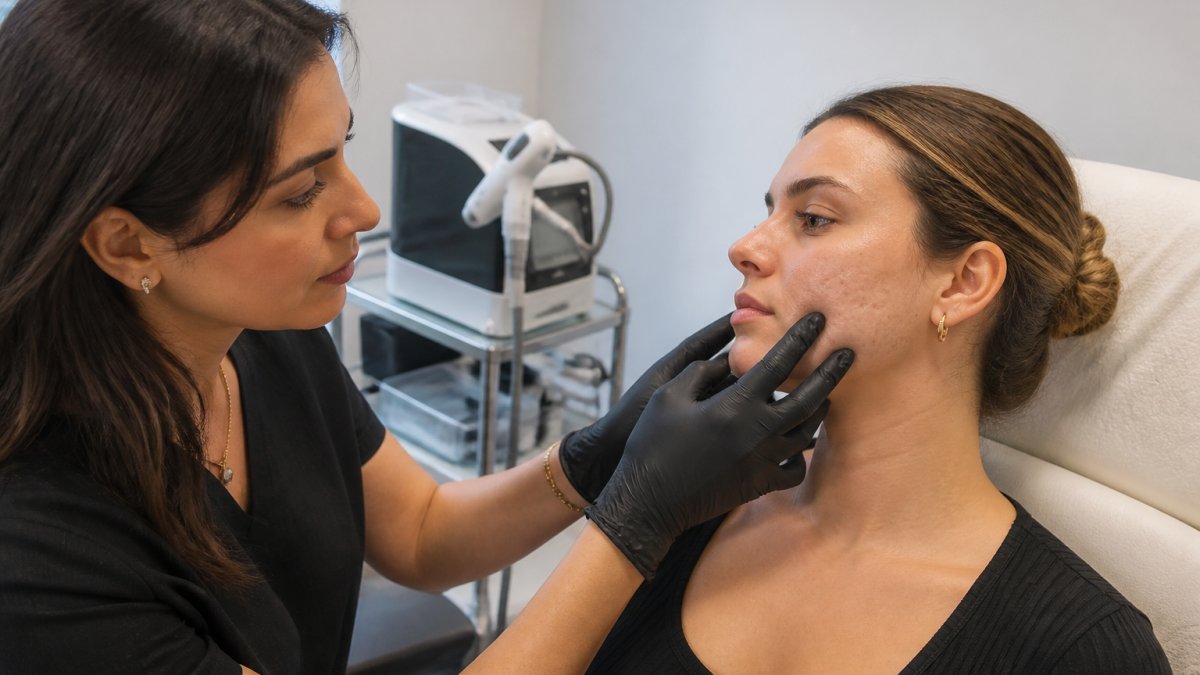
The key insight from current research is that there is no single best treatment. A 2026 review by Dr Caroline Warden states plainly that the best option depends on the scar type, not on which procedure is newest or most popular, as reported in The Best Treatments For Acne Scars In 2026, Dr Caroline Warden.
Here is how the main options compare:
| Treatment | Best For | Typical Sessions | Downtime |
|---|---|---|---|
| Laser resurfacing | Texture, pigmentation | 3-5 | 3-7 days |
| Radiofrequency microneedling | Darker skin tones, neck | 3-4 | 1-2 days |
| Injectables | Depressed or raised scars | 2-3 | Minimal |
| Punch excision | Severe, deep scars | 1-2 | 1-2 weeks |
Resurfacing and Laser Approaches
Laser treatment for old scars works by removing damaged surface layers and prompting new collagen. Fractional and picosecond lasers are the most common choices.
These suit flat scars, pigmentation marks, and mild texture issues. They are less effective on deep, tethered scars.
Microneedling, Radiofrequency and Injectables
Radiofrequency microneedling is a minimally invasive option that a 2025 review especially recommends for acne scars in darker skin types and for neck rejuvenation, according to Advancements in Acne Scar Treatment, PubMed Central.
Injectables help fill depressed scars or soften raised ones. They are quick and low-risk, but results are temporary.
Laser Treatment for Old Scars: What the Evidence Shows
Laser treatment for old scars has the strongest published evidence of any single approach. The picosecond data above is the clearest example.
But lasers are not a universal fix. They work best on surface-level concerns. If your scar is deep and tethered to underlying tissue, a laser alone will disappoint you.
Severe or Textured Scars: When Resurfacing Is Not Enough
Severe scars often need a different plan. Research published in the Journal of Cutaneous and Aesthetic Surgery found that grade 4 scars, the most severe category, improve poorly with resurfacing procedures, as detailed in Evidence-based Surgical Management of Post-acne Scarring in Skin of Colour, Journal of Cutaneous and Aesthetic Surgery.
For these scars, punch excision and punch elevation become the better options. Both remove or lift the scar tissue directly rather than resurfacing around it.
The same research also reported that platelet-rich plasma therapy was effective. This uses your own blood components to support healing.
If a clinic promises to fix grade 4 scarring with a standard laser package, be sceptical. Severe scarring usually needs a combined approach.
How Long Does Scar Treatment Take?
How long does scar treatment take? Most plans run across three to six sessions spaced four to six weeks apart, so expect two to six months from start to finish. Results keep improving for months after the final session as collagen rebuilds.
That timeline surprises people. Scar treatment is not a single appointment.
A realistic schedule looks like this:
- Consultation: 30-45 minutes, once
- Treatment sessions: 30-60 minutes each, every 4-6 weeks
- Collagen remodelling: continues for 3-6 months after treatment
- Maintenance: occasional top-ups, depending on the scar
At Glow with Fatima, a three-session protocol is offered because it gives skin time to respond between visits. Rushing sessions closer together does not speed things up.
Professional Scar Treatment Cost: What You Are Paying For
Professional scar treatment cost depends on the treatment type, the number of sessions, and the size of the area. Pricing depends on the treatment type, the number of sessions, and the size of the area. Every plan is built around your specific scar.
What you are actually paying for is not just the session time. It is:
- Medical-grade equipment that is CE- and UKCA-certified
- A practitioner trained to assess scar type before treating
- A plan built around your skin, not a generic package
- Follow-up and adjustment as your skin responds
A single salon facial and a clinical scar protocol are not the same service, even if both involve a device on your face.
Risks, Realistic Results and the Case for an Early Start
Professional treatment can improve an old scar, but results are rarely as dramatic as they would have been with early intervention. The source material on early scar treatment makes this clear: older scars do improve, but outcomes are more pronounced when treatment begins sooner, as noted by Why Early Scar Treatment Ensures Optimal Skin Recovery, Patrick Bitter Jr MD.
This does not mean old scars are hopeless. It means your expectations should be calibrated.
Risks are generally low. The picosecond review reported no severe adverse events. But possible side effects include:
- Temporary redness or swelling
- Pigment changes, especially in darker skin
- Infection, in rare cases
- Results that fall short of your hopes
The last one is the most common disappointment. Not because treatment failed, but because expectations were never set honestly.
Conclusion: Is Professional Scar Treatment Worth It for Old Scars?
For many people, yes. When the scar type matches the treatment, the evidence supports real improvement. The picosecond data showing scar-volume reduction in 75% of patients is not marketing talk.
But it is worth it only when the plan is honest. That means a proper assessment, the right device for your scar, and a realistic timeline.
At Glow with Fatima, every plan starts with a consultation. They use CE and UKCA-certified medical-grade equipment, offer a three-session protocol built around your skin, and aim to tell you plainly what is achievable before you commit. If you have an old scar you have given up on, book a free consultation and find out what is actually possible.
Frequently Asked Questions
Can old scars still be treated professionally?
Yes. Scar tissue remodels for years after an injury, so old scar treatment can still improve texture and volume. Results tend to be less dramatic than treating a fresh scar early, but a 2025 review in PubMed Central reported significant scar-volume reduction in 75% of patients after picosecond laser treatment, with no severe adverse events. A clinician will assess your scar type before recommending a plan.
Is laser treatment for old scars effective?
Laser treatment for old scars can be effective, particularly for raised, textured or pigmented scars. The same 2025 review found significant scar-volume reduction in 75% of patients after picosecond laser treatment. However, grade 4 scars improve poorly with resurfacing procedures, according to the Journal of Cutaneous and Aesthetic Surgery, so punch excision or punch elevation may be suggested instead. Suitability depends on your scar type.
How many treatments might an old scar need?
Most old scars need a course rather than a single session. How long scar treatment takes varies with scar type, depth and the method used. At Glow with Fatima, for example, a 3-session protocol is offered for optimal results on scarring and texture. Some severe or indented scars may need punch techniques plus follow-up resurfacing. Your clinician will map a realistic schedule at consultation.
How much does professional scar treatment cost?
Professional scar treatment cost depends on the number of sessions, the technology used and the size of the area treated. Pricing is bespoke, so it is best to request a quote after a consultation rather than rely on generic figures. The investment covers medical-grade equipment, clinical expertise and a personalised protocol. Book a free consultation with Glow with Fatima to get an accurate price for your scar.
Your questions, answered
Can old scars still be treated professionally?
Yes. Scar tissue remodels for years after an injury, so old scar treatment can still improve texture and volume. Results tend to be less dramatic than treating a fresh scar early, but a 2025 review in PubMed Central reported significant scar-volume reduction in 75% of patients after picosecond laser treatment, with no severe adverse events. A clinician will assess your scar type before recommending a plan.
Is laser treatment for old scars effective?
Laser treatment for old scars can be effective, particularly for raised, textured or pigmented scars. The same 2025 review found significant scar-volume reduction in 75% of patients after picosecond laser treatment. However, grade 4 scars improve poorly with resurfacing procedures, according to the Journal of Cutaneous and Aesthetic Surgery, so punch excision or punch elevation may be suggested instead. Suitability depends on your scar type.
How many treatments might an old scar need?
Most old scars need a course rather than a single session. How long scar treatment takes varies with scar type, depth and the method used. At Glow with Fatima, for example, a 3-session protocol is offered for optimal results on scarring and texture. Some severe or indented scars may need punch techniques plus follow-up resurfacing. Your clinician will map a realistic schedule at consultation.
How much does professional scar treatment cost?
Professional scar treatment cost depends on the number of sessions, the technology used and the size of the area treated. Pricing is bespoke, so it is best to request a quote after a consultation rather than rely on generic figures. The investment covers medical-grade equipment, clinical expertise and a personalised protocol. Book a free consultation with Glow with Fatima to get an accurate price for your scar.