ultimate-guide
Natural Aesthetic Treatments for Fine Lines: 2026 Guide
Table of Contents
- Why Fine Lines Form and What Natural Treatments Can Do
- Clinical Skincare and Advanced Skin Rejuvenating Face Wash
- Non-Invasive Skin Tightening Benefits for Fine Lines
- Clinical Facial Rejuvenation Recovery Time: What to Expect
- Injectable Minimalism and Regenerative Trends in 2026
- Lifestyle Factors That Affect Fine Lines
- How to Choose a Provider for Natural Aesthetic Treatments
- Frequently Asked Questions
Last Updated: September 13, 2026
Why Fine Lines Form and What Natural Treatments Can Do
Natural aesthetic treatments for fine lines work by supporting the skin's own repair processes rather than paralysing or filling it. According to Galderma's 2026 global survey on anti-wrinkle treatment expectations, 86% of patients rate natural-looking results among their top three priorities, which explains why demand is shifting away from heavy intervention.
Fine lines form when collagen and elastin production slows, repeated muscle movement etches creases into the skin, and sun exposure breaks down the supporting matrix underneath. Fine lines form when collagen and elastin production slows, repeated muscle movement etches creases into the skin, and sun exposure breaks down the supporting matrix underneath.
Here's what most guides get wrong: they treat "natural" and "clinical" as opposites. They aren't. The treatments with the strongest evidence behind them, from microneedling to specific topical actives, are both.
Below, we break down what actually works, what the research supports, and how to build a routine that respects your skin rather than fighting it.
Clinical Skincare and Advanced Skin Rejuvenating Face Wash
An advanced skin rejuvenating face wash is a cleansing formula built around active ingredients that support the skin barrier while removing daily buildup, rather than simply stripping oil. The distinction matters more than most people realise.
Most high-street cleansers do their job too well. They remove everything, including the lipids your barrier needs, and the tight feeling afterwards is damage, not cleanliness. A clinical cleanser uses gentler surfactants and often adds niacinamide, ceramides, or hydrating agents so the skin finishes the wash calmer than it started.
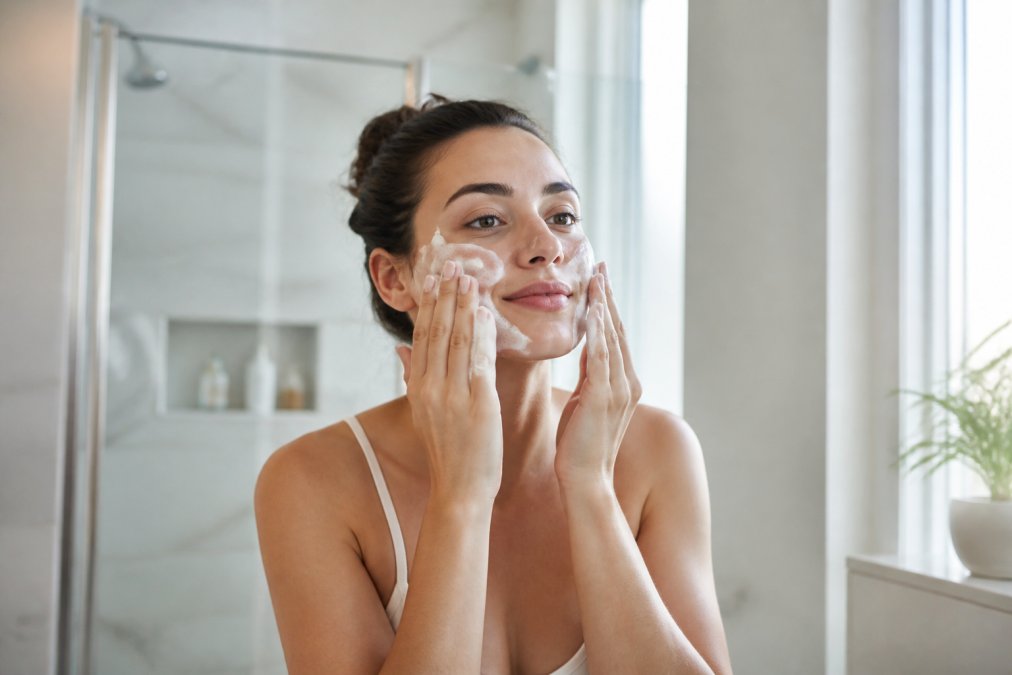
Cleansing is the step you repeat twice daily for decades. Get it wrong and every serum layered on top is working against a compromised barrier. Get it right and the rest of your routine performs better.
Ingredients That Have Evidence Behind Them
Retinol, niacinamide, and vitamin C carry the strongest published support for fine lines and uneven tone. A 12-week study published in the Journal of Drugs in Dermatology found that a topical combination of retinol, niacinamide, and Terminalia chebula produced measurable reductions in fine lines and skin redness.
What the evidence does not support is the long tail of "miracle" botanicals. Research indexed by EBSCO Research Starters on natural anti-ageing ingredients found that while soy products reduced fine wrinkles, their effect on deeper linear wrinkles was not significant compared with placebo. That's a useful reality check.
Ingredients worth building around:
- Retinol: stimulates cell turnover, best introduced slowly at night
- Niacinamide: supports the barrier and evens tone
- Vitamin C: antioxidant protection against daily environmental stress
- Hyaluronic acid: hydration that plumps the surface temporarily
How to Build a Routine That Supports Collagen
Collagen support comes from consistency, not intensity. Four steps, morning and evening, done properly for months, outperform a shelf of products used sporadically.
Morning: gentle cleanse, vitamin C serum, moisturiser, broad-spectrum SPF 30 or higher. Evening: cleanse, retinol two to three nights per week to start, moisturiser.
The single most common mistake is introducing retinol and acids in the same week. Your barrier will not thank you. Space new actives four weeks apart and let each one settle before adding the next.
Non-Invasive Skin Tightening Benefits for Fine Lines
Non-invasive skin tightening benefits centre on collagen stimulation without cutting, injecting, or downtime. Treatments such as radiofrequency microneedling and nano-needling create controlled micro-injury that prompts the skin to rebuild its own support structure.
A 2025 review in PMC, the National Library of Medicine's open-access archive confirmed that traditional microneedling, radiofrequency microneedling, and nano-needling all produce marked improvements in skin quality through collagen production. The mechanism is the same in each case: controlled stress, followed by repair.
The practical advantage for fine lines specifically is that tightening improves the whole surface rather than targeting one crease. Skin looks firmer, pores appear smaller, and texture smooths. The trade-off is patience. Collagen remodelling takes weeks to show and months to peak.
This is why a three-session protocol is often recommended rather than offering one-off appointments. Single sessions feel productive. Three sessions, spaced correctly, actually change the skin.
Clinical Facial Rejuvenation Recovery Time: What to Expect
Clinical facial rejuvenation recovery time ranges from zero downtime for nano-needling to roughly three to five days of redness and mild flaking after radiofrequency microneedling. Most clients return to work the next day with light makeup.
| Treatment type | Typical downtime | When results appear | Best for |
|---|---|---|---|
| Nano-needling | None to 24 hours | 2-4 weeks | First fine lines, sensitive skin |
| Traditional microneedling | 24-48 hours | 4-6 weeks | Texture, early scarring |
| Radiofrequency microneedling | 3-5 days | 6-12 weeks | Firmness, deeper lines |
| Topical retinoid routine | None | 8-12 weeks | Prevention, tone |
The honest version: day one after radiofrequency microneedling looks worse than day one after a facial. Redness is expected and it is the treatment working. By day three most people are back to normal, and by week six the difference is visible in photographs rather than in the mirror.
Injectable Minimalism and Regenerative Trends in 2026
Injectable minimalism is the 2026 shift toward small, strategic doses that soften dynamic lines while preserving natural facial expression. The global pro-ageing aesthetic market reached $7.1 billion in 2026, with a projected 12% annual growth rate through 2033, according to Grand View Research's pro-ageing aesthetic market report.
The numbers behind individual treatments are striking. Rejuran, a bio-rejuvenation treatment, grew 93,800% in adoption in 2026, according to LaserAway's 2026 trending aesthetic treatments analysis. Neuromodulator treatment volume rose 49.9% in the same period. Regenerative approaches, sometimes called collagen banking, are now a mainstream conversation rather than a specialist one.
What this means in practice is fewer units, placed more carefully. The goal has moved from visible correction to quiet optimisation.
Lifestyle Factors That Affect Fine Lines
Sleep, sun exposure, alcohol, and smoking all show up on the face before anything else does. None of them are glamorous to discuss, and all of them matter more than the serum you choose.
Sun exposure remains the dominant factor. Daily SPF, reapplied, does more for fine lines over ten years than any single in-clinic treatment. Sleep quality runs second: skin repair happens overnight, and chronic short sleep shows as dullness and faster line formation.
Smoking constricts blood vessels and reduces oxygen delivery to skin tissue. Alcohol dehydrates and disrupts sleep architecture. Neither is a moral failing, but both are worth knowing about if you are investing in treatment.
The lifestyle changes with the clearest return:
- Broad-spectrum SPF every morning, regardless of weather
- Seven to nine hours of sleep
- Limiting alcohol to a level your skin tolerates
- Staying hydrated and eating enough protein for collagen synthesis
How to Choose a Provider for Natural Aesthetic Treatments
Choosing a provider for natural aesthetic treatments comes down to three things: evidence, equipment certification, and whether they will tell you no. A clinic that says yes to everything is not a clinic you want.
Ask directly which devices they use and whether those devices carry CE or UKCA certification. Medical-grade equipment should be traceable. Ask how many sessions a realistic result takes, and be suspicious of anyone promising a single-session transformation.
At Glow with Fatima, every treatment plan starts with a consultation and an honest assessment of what your skin can and cannot achieve. The studio was founded by a practitioner with a clinical care background, and the Raffine medical-grade microneedling system we use is CE and UKCA certified.
A short checklist before you book anywhere:
- Can they name the device and its certification?
- Do they recommend a session protocol rather than a one-off?
- Will they discuss what will not work for your skin?
- Do they ask about your medical history and postpartum status?
- Is the consultation free and without pressure?
Fine lines are not a problem you solve once. They are a slow process you manage, and the results compound when your routine, your lifestyle, and your in-clinic treatments all pull in the same direction. Glow with Fatima builds bespoke plans around evidence-based treatments, a three-session protocol for measurable change, and medical-grade equipment that is CE and UKCA certified. If you want a plan that respects your skin, book a free consultation and find out what is actually achievable for yours.
Frequently Asked Questions
Can fine lines be reduced without surgical intervention?
Yes. Non-surgical options such as microneedling, radiofrequency, and clinical-grade skincare have shown measurable improvements in skin quality by stimulating collagen production. A 2025 review in PMC found that traditional microneedling, radiofrequency microneedling, and nano-needling all promote collagen and improve fine lines. Results build over a series of sessions, typically three, and deepen with consistent aftercare. Natural aesthetic treatments focus on restoring skin function rather than paralysing muscles, so expression remains intact.
How long do the results of natural aesthetic treatments typically last?
It depends on the treatment. Collagen-stimulating procedures like microneedling and radiofrequency produce results that can last six to twelve months as new collagen matures. Injectable neuromodulators typically last three to four months. Regenerative treatments aim for longer-lasting bio-rejuvenation. Maintenance sessions and daily skincare extend results. Your provider should map a schedule based on your skin's response and goals.
Are non-invasive aesthetic treatments suitable for all skin types?
Most are suitable for a wide range of skin types, but not all. Radiofrequency and microneedling are generally safe for Fitzpatrick I to IV, with adjustments for darker skin tones to avoid post-inflammatory hyperpigmentation. Active acne, cold sores, or recent isotretinoin use may require postponement. A thorough consultation and patch test ensure safety. Providers using CE- and UKCA-certified equipment can tailor settings to your skin's needs.
What role does collagen production play in smoothing fine lines?
Collagen gives skin its structure and elasticity. From your mid-twenties, natural collagen production declines by about 1% per year, leading to fine lines and laxity. Treatments like microneedling create controlled micro-injuries that trigger the skin's repair response, boosting collagen and elastin. A 2022 study in the Journal of Drugs in Dermatology found that a topical combination of retinol, niacinamide, and Terminalia chebula reduced fine lines and dyspigmentation over 12 weeks, partly by supporting collagen synthesis.
Your questions, answered
Can fine lines be reduced without surgical intervention?
Yes. Non-surgical options such as microneedling, radiofrequency, and clinical-grade skincare have shown measurable improvements in skin quality by stimulating collagen production. A 2025 review in PMC found that traditional microneedling, radiofrequency microneedling, and nano-needling all promote collagen and improve fine lines. Results build over a series of sessions, typically three, and deepen with consistent aftercare. Natural aesthetic treatments focus on restoring skin function rather than paralysing muscles, so expression remains intact.
How long do the results of natural aesthetic treatments typically last?
It depends on the treatment. Collagen-stimulating procedures like microneedling and radiofrequency produce results that can last six to twelve months as new collagen matures. Injectable neuromodulators typically last three to four months. Regenerative treatments aim for longer-lasting bio-rejuvenation. Maintenance sessions and daily skincare extend results. Your provider should map a schedule based on your skin's response and goals.
Are non-invasive aesthetic treatments suitable for all skin types?
Most are suitable for a wide range of skin types, but not all. Radiofrequency and microneedling are generally safe for Fitzpatrick I to IV, with adjustments for darker skin tones to avoid post-inflammatory hyperpigmentation. Active acne, cold sores, or recent isotretinoin use may require postponement. A thorough consultation and patch test ensure safety. Providers using CE- and UKCA-certified equipment can tailor settings to your skin's needs.
What role does collagen production play in smoothing fine lines?
Collagen gives skin its structure and elasticity. From your mid-twenties, natural collagen production declines by about 1% per year, leading to fine lines and laxity. Treatments like microneedling create controlled micro-injuries that trigger the skin's repair response, boosting collagen and elastin. A 2022 study in the Journal of Drugs in Dermatology found that a topical combination of retinol, niacinamide, and Terminalia chebula reduced fine lines and dyspigmentation over 12 weeks, partly by supporting collagen synthesis.